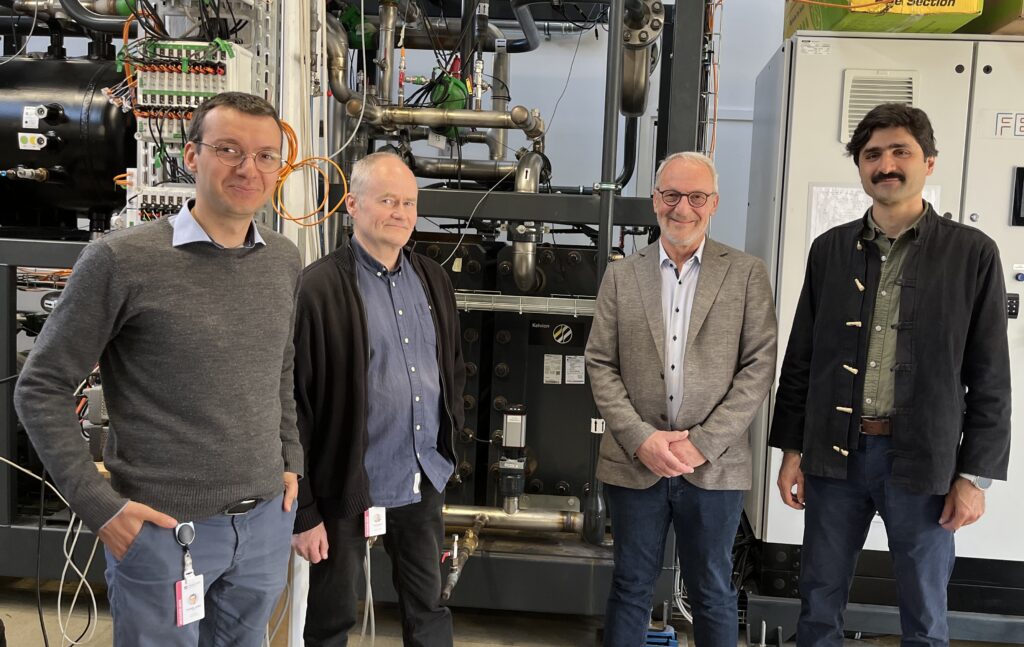
In May 2026, representatives from Kelvion and Danish Technological Institute (DTI) met at DTI’s facilities in Aarhus. The purpose of the visit was to inspect the prototype setup developed within the HP2MIX project and to carry out initial technical evaluations of the system’s heat exchangers under zeotropic operating conditions.
The visit provided an opportunity for the project partners to align on technical details and meet in person. Kelvion was represented by Key Account Manager Lars Knudsen and Thermal Engineer Prof. Dr Sepehr Foroushani. The DTI project team was represented by Project Manager Pierre-Jean Delêtre and Senior Project Manager Jóhannes Kristófersson.
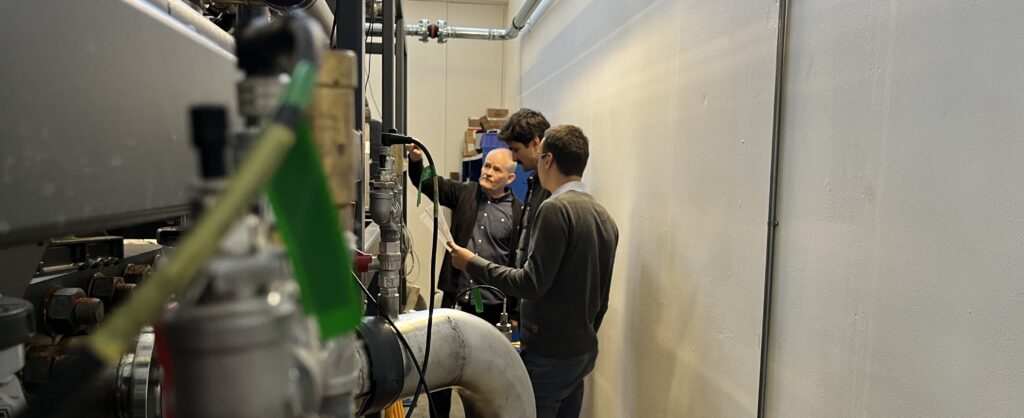
The Critical Role of Heat Exchangers in Systems Using Zeotropic Mixtures
In conventional heat pumps, pure refrigerants evaporate and condense at a constant temperature. The HP2MIX project, however, utilizes natural zeotropic mixtures (based on hydrocarbons). These mixtures experience a temperature glide during phase change, meaning that the temperature changes as the fluid evaporates or condenses.
By matching this temperature glide with the temperature changes of the heat source and heat sink, exergy losses in the heat exchangers can be significantly reduced. This glide-matching is the primary mechanism for achieving the project’s target of a 20% to 30% increase in Coefficient of Performance (COP).
However, utilizing zeotropic mixtures introduces specific technical challenges for heat exchanger design, which are a major focus of the partnership:
– Mass Diffusion Resistance:
During phase change, zeotropic mixtures experience mass diffusion resistance, which typically degrades the heat transfer coefficient compared to pure fluids. To prevent the need for excessively large and costly equipment, the plate heat exchangers must be geometrically optimized to maintain high heat transfer rates.
– Refrigerant Charge Minimization:
Because the project utilizes flammable hydrocarbons, safety is a key parameter. The project targets a 20% reduction in refrigerant charge per kW of heating capacity. This requires the development of compact plate heat exchangers with minimal internal volume that still deliver optimal thermal performance.
– Phase Distribution:
Ensuring a uniform distribution of the liquid and vapour phases across the heat exchanger plates is critical to maintaining stable operation and avoiding local dry-outs.
– Refrigerant Glide:
Provides benefits for the system but also represents a risk of freezing of the heat exchanger in case of e.g. a large subcooling degree.
Inspection and Freezing Tests on the 20 kW Prototype
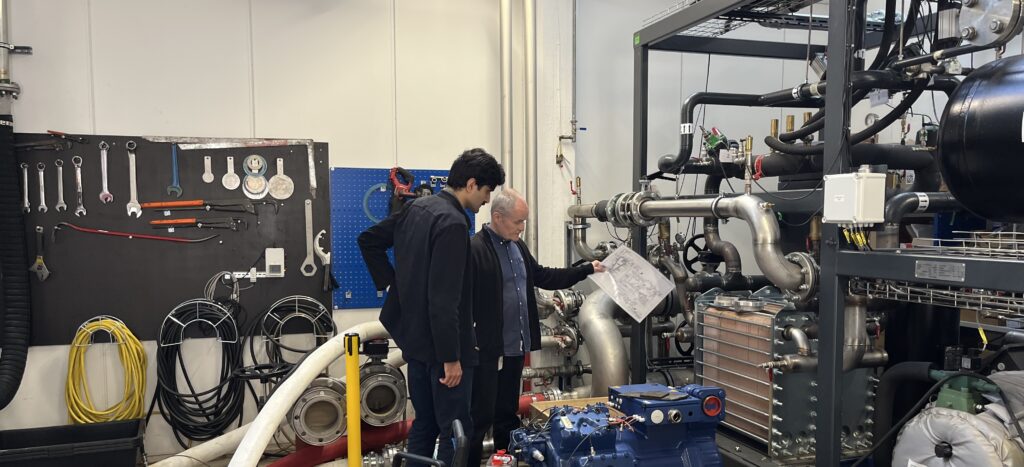
The main focus of the visit was the 20 kW HP2MIX prototype heat pump, currently installed in DTI’s laboratory. This small-scale setup serves as a testbed to validate component designs, including Kelvion’s customized brazed plate heat exchangers, before scaling up to larger systems.
During the visit, the partners inspected the physical installation, the measuring equipment, and the project’s online data platform.
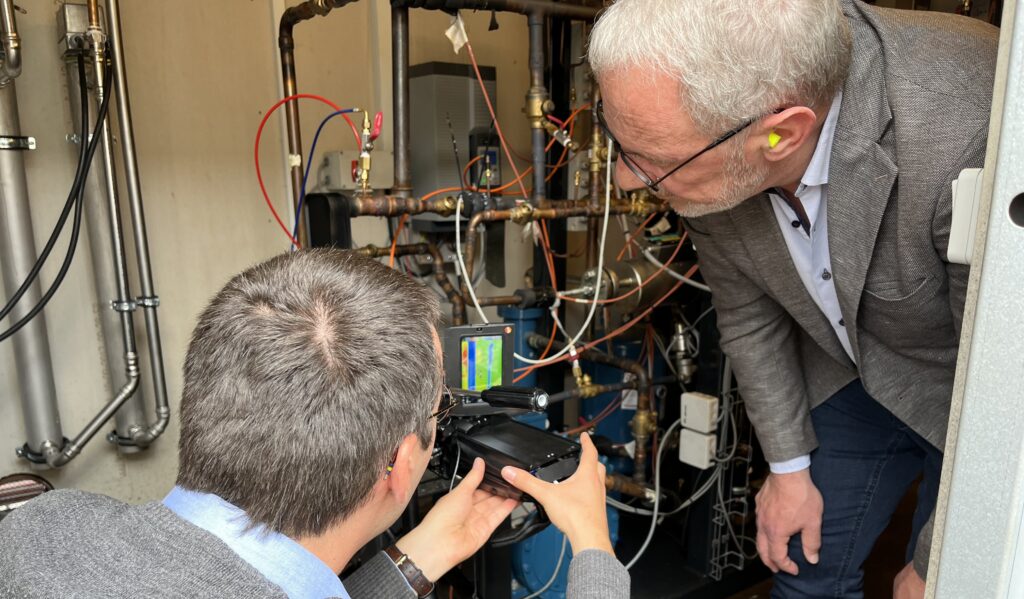
The team also conducted a short freezing test on the evaporator. By systematically lowering the evaporating temperature to induce ice formation, the partners collected data to:
– Identify the physical and thermal operating limits of the heat exchanger.
– Gather data to help prevent freezing in future operations.
– Support the development of operating recommendations and control strategies for end-users.
Regarding the testing platform, Prof. Dr Sepehr Foroushani noted:
I really like the test setup and data visualization tool at DTI. It’s a bit daunting the first time with so many options, but already from the second time it was very intuitive and really useful.
From 20 kW Prototype to 500 kW Demonstration
The HP2MIX project aims to support the decarbonisation of industrial process heat and district heating. The data and insights gained from the 20 kW prototype tests in Aarhus will directly be used to support the design of a 500 kW demonstration plant. This full-scale system is planned for installation at one of Innargi’s geothermal district heating sites to prove the technology’s performance and reliability under real-world conditions.
For the HP2MIX project, the immediate next steps include:
– Temperature Profile Testing:
Evaluating the remaining temperature profiles defined in the project (the Innargi geothermal profiles).
– Further Freezing Tests:
Carrying out freezing tests with different heat exchanger designs.
– Liquid Distributor Evaluation:
Investigating how different liquid distributor configurations impact fluid distribution and heat transfer performance in the evaporator.
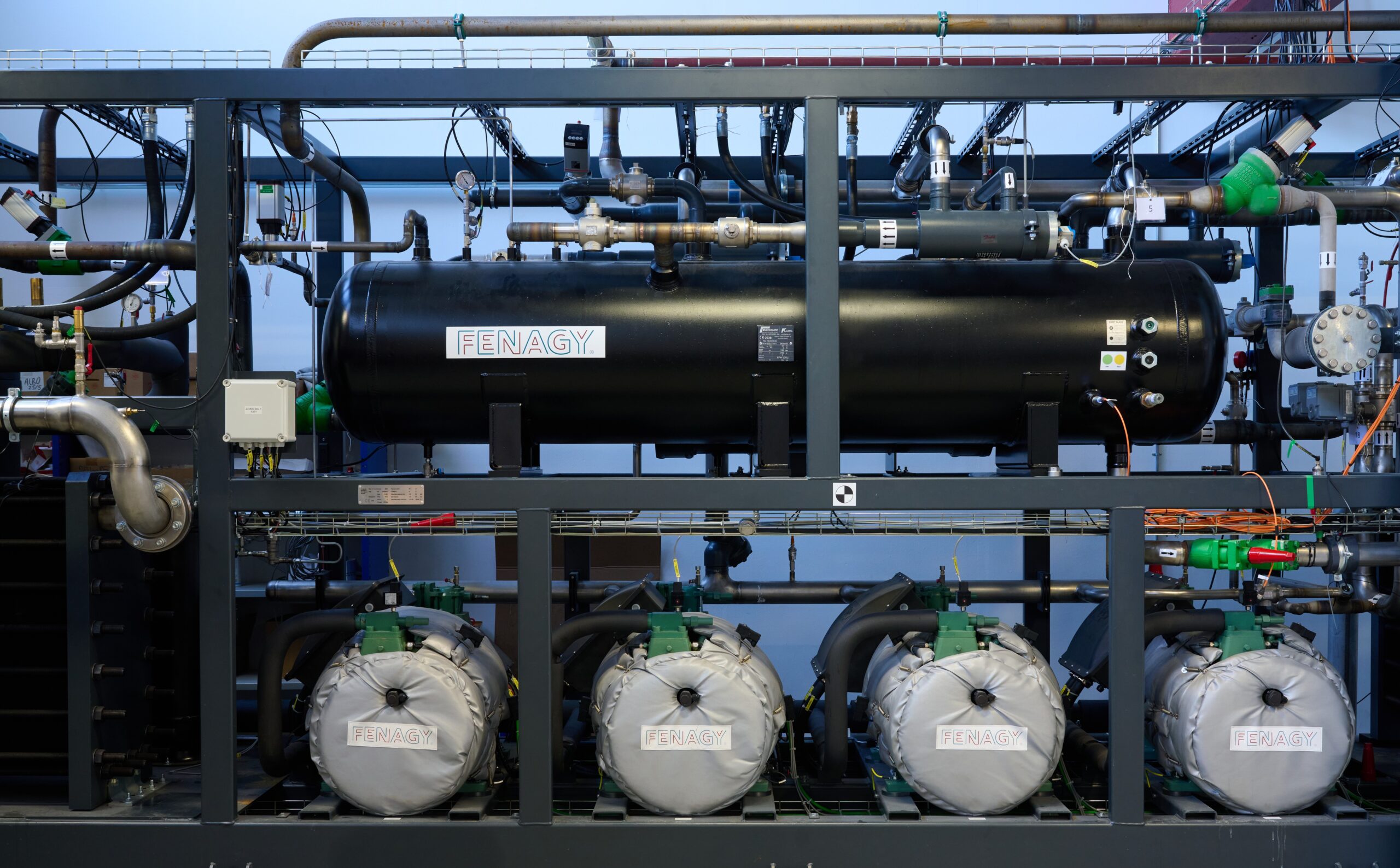
During the laboratory visit, the partners also took the opportunity to inspect the FORCO2 rig. This sister project - which also counts both DTI and Kelvion as partners - focuses on developing reversible CO2 chiller and heat pump units. Kelvion and DTI plan to test additional heat exchangers on the FORCO2 rig in the near future, leveraging strong technical synergies between the two projects.
Watch the video from the visit

The FORCO2 Project
Full project title: Future Optimised Reversible CO2 Chiller and Heat Pump (FORCO2)
Project period: 2022-2025
Objective: To develop a novel, factory-built reversible chiller and heat pump unit using the environmentally friendly and safe natural refrigerant CO2. By combining heating and cooling into a single, highly efficient unit, the system replaces two traditional systems (a separate chiller and boiler), significantly reducing energy consumption and carbon emissions.
Project partners: Danish Technological Institute (Project Manager), Kelvion, Fenagy, Bitzer Electronics A/S, Danfoss, Güntner, Elcon, CO2X, DTU Construct, Arla Foods
The project is funded by the Danish Energy Technology Development and Demonstration Programme (EUDP).